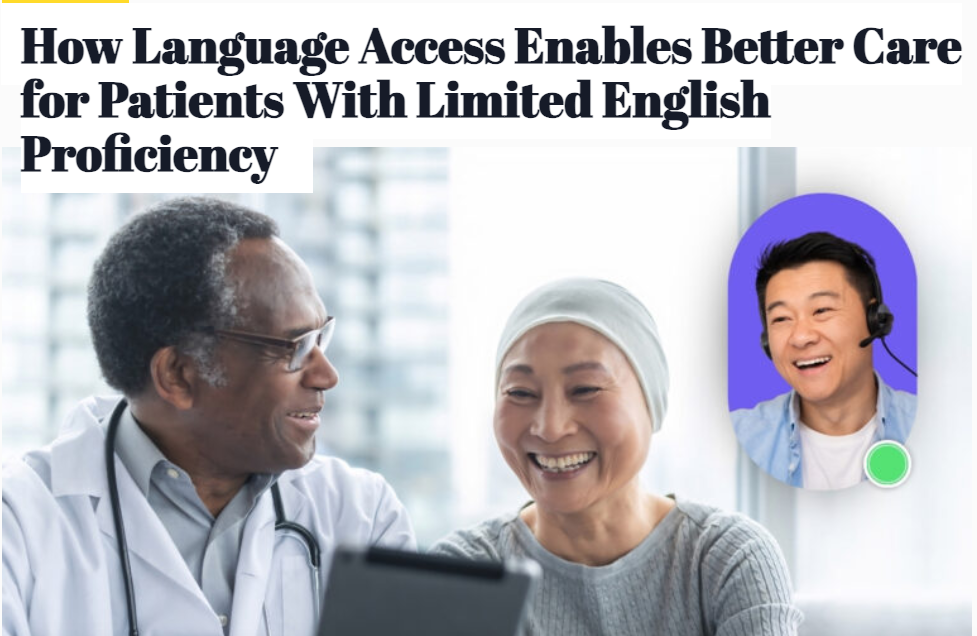
Our co-founder weighs in on why language access belongs in every patient safety conversation.
When a clinician misunderstands how a patient describes their symptoms, the consequences can start small and end up serious. Whether it happens at intake, consent, treatment, or discharge, a communication gap can turn a routine exchange into a high-stakes one.
That’s the starting point for a new patient safety editorial by Dr. Richard Brecht, Jeenie’s Co-Founder and Chief Language Officer, in USA TODAY’s Special Issue: Future of Personal Health.
Why language access is a patient safety issue
Patients with limited English proficiency (LEP), meaning they speak English less than “very well,” face this risk at every stage of care. And the data shows it. In a peer-reviewed study of adverse events in U.S. hospitals, 52.4% of events involving LEP patients were linked to communication errors, compared with 35.9% for English-speaking patients.
Those numbers point to a simple idea: safe care depends on being understood. That’s why Dr. Brecht argues that language access isn’t an add-on. It belongs in every patient safety conversation.
Who interprets matters
It isn’t enough for language support to exist. The article makes the case that it has to be professional and HIPAA-certified, and it digs into what the evidence says about relying on family members or untrained bilingual staff instead. It also looks at the cost-effectiveness case health systems should weigh, from malpractice exposure to clinician time.
We’ll leave the details for the article itself.
What this looks like in practice
At Jeenie, our platform connects clinicians to qualified interpreters in 300+ languages, including ASL and rare and Indigenous languages, on demand. Our network of more than 25,000 linguists has earned a 4.9-star client rating. Quality and access, built into the daily workflow, are what turn good intentions about patient safety into everyday practice.
Key takeaways
- Clear communication is patient safety.
- Language barriers can raise patient safety risk at every stage of care, from intake to discharge.
- Adverse events involving LEP patients were more often linked to communication errors (52.4%) than those involving English-speaking patients (35.9%).
- Qualified, HIPAA-certified professional interpreters are the standard for safe communication, not family members or untrained staff.
- Language access belongs in every patient safety conversation.
👉 Read Dr. Brecht’s full article in USA TODAY’s Special Issue: Future of Personal Health