California Health Care Foundation's report offers a compelling example of how AI can take repetitive work off linguists’ plates.
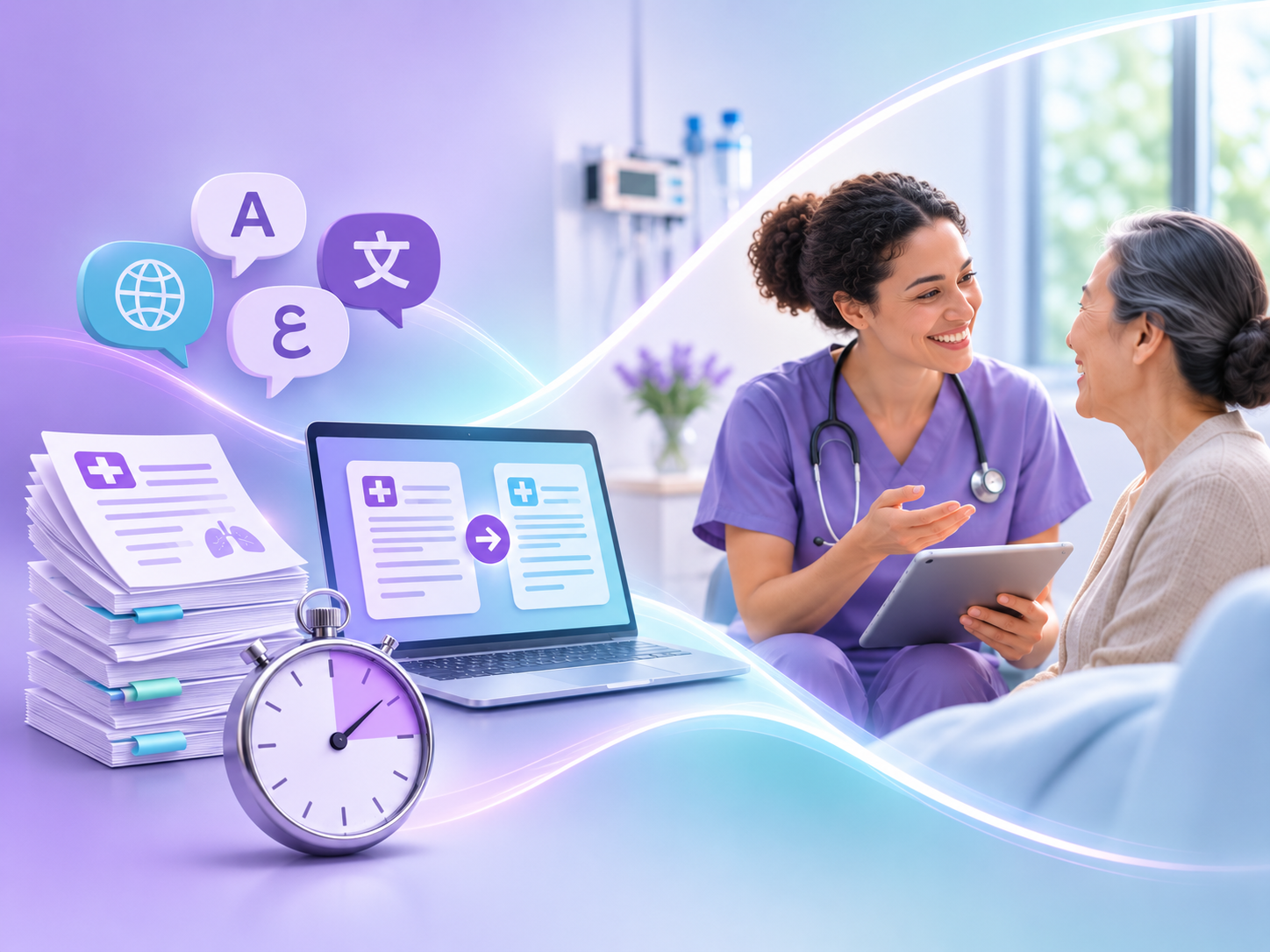
Picture a children’s hospital where about 70% of patients speak Spanish. Before it tried AI tools, its in-house language team (the report calls them interpreters) spent up to two hours translating the summaries and education materials for a single discharge. That time-intensive process limited the team’s capacity to prepare translated materials to roughly four discharges per day, delaying important information for families preparing to leave the hospital.
Today, the team reviews and finalizes an AI-drafted translation in 5-10 minutes.
Human review remained central. What changed was how the work got done.
That story is one of six in a March 20, 2026 report from the California Health Care Foundation (CHCF), AI and Language Access in Health Care: Opportunities, Risks, and Early Lessons. The bigger story isn’t that AI makes linguists faster. It’s that AI changes how we spend scarce human expertise, and getting that balance right can improve access for everyone.
Key findings from Children’s Hospital Los Angeles
The CHCF report highlights three significant results:
- Translation preparation time dropped from up to two hours to just 5-10 minutes per discharge.
- 100% of CHLA’s interpreters adopted the AI-assisted workflow for written discharge instructions.
- More than 99% of Spanish discharge summaries were rated medically acceptable in an internal evaluation conducted by the AI vendor using CHLA interpreter feedback, with most requested corrections involving style rather than substantive meaning.
These are early, promising results from a single hospital, and the quality evaluation was vendor-conducted. CHCF, an independent foundation, reports them alongside its own call for shared validation standards before anyone treats them as settled.
Translation vs. interpretation: a quick guide
- Translation converts written content from one language into another: discharge instructions, forms, letters, portal messages.
- Interpretation facilitates spoken or signed communication in real time, whether in person, over the phone, or through video.
Both take skilled linguists, but they are different tasks, and that difference decides where AI can safely help. Written work can be reviewed before it reaches a patient. A live conversation can’t. Notice that the CHLA results above are all about written translation.
What the early pilots have in common
- Low-risk content first: previsit instructions, preventive care reminders, education materials, after-visit notes, and routine administrative conversations.
- Support, not replacement: linguists review and approve machine drafts instead of translating from scratch. The report says this “human-in-the-loop” model is becoming the standard among safety-net providers.
- Costs, per vendors: emerging vendors claim AI-assisted workflows can cut costs by 50% to 70%, depending on the use case and quality checks. That’s a vendor claim, not a finding.
Where the human line falls
Federal and state rules still require qualified humans in clinical, legal, and consent-related conversations, and federal rules call for human review of machine translation when accuracy is essential or content is critical or complex. What’s less settled, as an attorney quoted in the report explains, is how to apply those requirements to AI-enabled care. The rules don’t spell out what counts as a “critical” conversation, so each health system ends up drawing its own line.
To help organizations navigate these decisions, CHCF proposes a hypothetical risk-based framework. It’s not an established regulatory standard, but it offers a useful starting point for thinking about where qualified interpreters should lead, where AI can assist with human oversight, and where validated automation may be appropriate.
| Tier | Examples | Human role |
|---|---|---|
| Human interpreter required | Informed consent, end-of-life talks, behavioral health visits, high-acuity emergency care, complex diagnoses | Leads the conversation |
| AI with human review | Discharge instructions for complex conditions, previsit education, routine follow-up | Reviews and approves |
| Potential AI-only use, with safeguards | Appointment reminders, basic navigation, nonurgent portal messages, mass communications | Validates templates up front |
Where AI still falls short
 Accuracy varies by language and by how it’s measured.
The report cites studies finding 83% to 98% accuracy in some settings when translating from English into well-resourced languages like Spanish or Portuguese, and notes performance declines considerably for more complex content and less-resourced languages.- Our own testing looks at a different task.
Our linguists and data scientists test leading AI models for spoken interpretation accuracy, one language at a time. Live interpretation leaves no time for review, and so far only a few dozen languages have met our standards for routine, everyday conversations. - Language gaps persist, particularly for less commonly served languages.
Contra Costa Health has 11 full-time interpreters for more than a dozen languages, including Khmu and Mayan languages. Staff reported overnight coverage gaps, dropped calls, and aging equipment. Those are service-delivery challenges that exist apart from AI. AI may eventually help close some of these gaps, but it has to be validated independently for each language and use case. - “Supported” can be misleading.
Language counts can be misleading. The report notes that traditional vendors often count any language with some interpreter coverage, even when availability is limited and waits are long.
Why this is good news for linguists, if it’s done right
There aren’t enough skilled linguists in the world to meet the demand. AI can help by taking repetitive work, like first drafts of written materials, off their plates, so they can spend their expertise where it counts: informed consent, a hard diagnosis, a family’s worst day. As hospitals in the pilot put it, the goal is to let linguists "practice at the top of their license."
Their roles grow, too:
- Translators review and approve machine drafts rather than starting from zero.
- Interpreters can be trained to supervise AI workflows and run quality checks, as the report recommends.
- Expert linguists become the standard AI is measured against, and the people who catch what a machine misses.
The report also names the risk. Asian Health Services, which serves more than 50,000 patients in 14 languages, sees AI as a way to stretch capacity, not cut jobs. Health Plan of San Joaquin warned that if cost and speed dominate, quality loses its voice. Efficiency should expand what linguists can do, not lower the standard of care.
How we’re approaching AI support at Jeenie
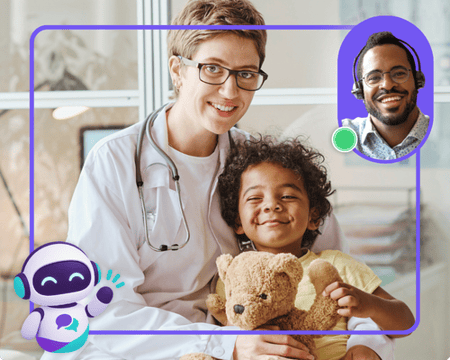
The research reinforces what we believe at Jeenie: the future of language access is hybrid. Not AI replacing human interpreters, but AI and qualified language professionals working together, each contributing where they bring the greatest value.
The key is knowing when to use each and making it seamless to move between them.
We're putting that philosophy into practice. Informed by our language-by-language AI model testing, Jeenie's AI interpreter is designed for appropriate routine, lower-risk conversations, working alongside our network of 25,000+ linguists. When a conversation requires greater nuance, expertise, or human connection, a qualified interpreter is just one tap away.
We're also a member of the Interpreting SAFE-AI Task Force, helping advance the standards and safeguards needed for responsible adoption.
Hybrid isn't simply about offering two ways to communicate.
It's about giving healthcare organizations the flexibility and control to use the right support for every interaction. It's about never compromising the quality and trust patients deserve.
The takeaway
- AI changes how scarce human expertise gets used.
The goal is to point human expertise to the moments that matter most. - Early pilots used AI for routine, written work, with humans reviewing the output.
- Written translation can be checked first.
Live interpretation can’t, which is why the human line matters. - Accuracy and coverage are uneven for less common languages.
Each language needs its own validation. - Linguists’ roles are growing, toward review, quality checks, and the hardest conversations.
Read the full report from CHCF:
AI and Language Access in Health Care: Opportunities, Risks, and Early Lessons
Interested in how smart Hybrid AI interpreting can improve access at your organization?