Language Access Is Becoming an Outcomes Strategy
For years, conversations about language access in healthcare centered on compliance, equity, and patient rights. Today, the conversation is changing. Recent actions from The Joint Commission, growing attention to patient safety, and findings from the U.S. Commission on Civil Rights all point to the same conclusion: communication isn't separate from care, it helps determine whether care succeeds.
Now, California's Medical Interpreter Pilot Project (MIPP) evaluation adds some of the strongest real-world evidence yet to support that shift.
The newly released evaluation examined more than 8,700 interpreted clinical encounters involving patients with limited English proficiency (LEP). What researchers found wasn't simply better communication. They found measurable improvements in healthcare quality indicators, patient engagement, and follow-through. That distinction matters.
A Massive Real-World Eval of Medical Interpretation.
The scale of MIPP is difficult to ignore.
Over a two-year period, professional interpreters supported 8,702 clinical encounters involving 4,126 members with LEP, delivering more than 320,000 minutes of interpretation across 31 languages and 23 service areas.
Importantly, this wasn't a small pilot asking whether patients liked interpreter services.
Researchers evaluated patient experiences, clinician experiences, healthcare utilization, and quality measures across real-world healthcare settings. The result is one of the most substantial recent evaluations of professional medical interpretation in the United States.
The Surprising Finding:
Not Just Better Conversations, Better Outcomes.
Most healthcare leaders would expect professional interpreters to improve communication.
What's more noteworthy is how far the impact appears to extend.
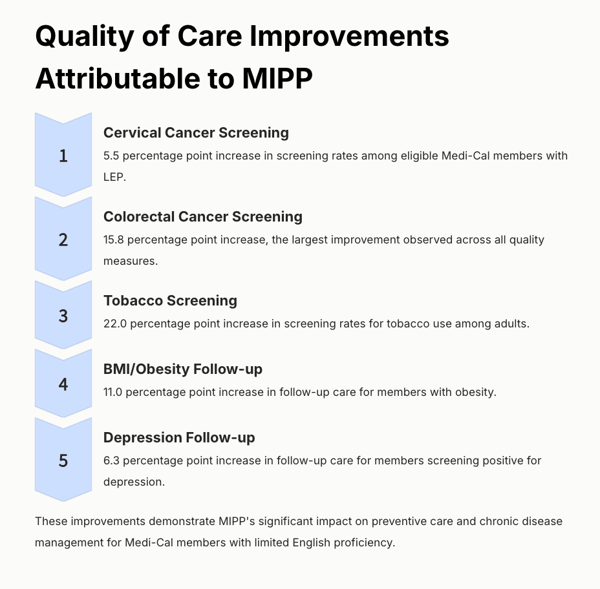
The evaluation found statistically significant improvements in several quality measures, including cervical cancer screening, colorectal cancer screening, tobacco screening, obesity follow-up, and depression follow-up. Researchers also documented stronger medication adherence, improved patient understanding of treatment plans, and better patient-clinician relationships.
Those aren't language-access metrics. They're healthcare quality metrics.
The findings suggest that language access may influence much more than a single clinical conversation. It may affect whether patients remain engaged in care, follow recommendations, and complete important preventive services.
Cost Savings.
The business case for professional interpreters.
The evaluation also reinforces an important business case for language access. Researchers projected that improvements in preventive care could translate into substantial long-term cost savings by preventing disease progression, reducing emergency department utilization, avoiding costly inpatient care, and improving chronic disease management.
-
One example: the 15.8 percentage point increase in colorectal cancer screening alone was projected to prevent 31 colorectal cancer cases and 11 deaths.
Clinics also reported more immediate operational benefits, including fewer communication-related errors, more efficient interpreter access, reduced reliance on fragmented language services, and better treatment adherence. Together, these findings suggest that investing in professional medical interpretation isn't simply a compliance or equity initiative—it can also improve operational efficiency while reducing downstream healthcare costs.
A Key Takeaway.
The most interesting lesson from MIPP may not be the screening improvements themselves.
It may be the pathway that led to them...Across clinician interviews, patient feedback, and quality measures, a consistent pattern emerged: when patients better understood diagnoses, treatment plans, medications, and next steps, they were more likely to stay engaged with care and complete recommended services.
Language Access → Better Understanding → Stronger Engagement → Better Follow-Through → Measurable Quality Improvements
That observation helps explain why improvements appeared in areas like preventive screenings, medication adherence, and follow-up care. Understanding matters, but trust and engagement are often what determine whether patients act on that understanding.
One of the report's most compelling findings:
Better Communication Enables More Personalized Care.
Interpreters appeared to contribute to more patient-centered care, not simply more accurate communication. MIPP was specifically designed around culturally competent medical interpretation. Interpreters were trained to recognize how factors such as family dynamics, gender roles, religious beliefs, and health practices can influence communication and decision-making. They were also expected to help clinicians facilitate informed decision-making while ensuring patients felt heard and understood.
Clinicians reported that professional interpreters helped bridge communication gaps, provide more complete patient histories, improve health education, and support treatment plans tailored to patient needs. In some cases, interpretation services expanded access to services that had historically been less accessible to patients with LEP, including behavioral health and dental care.
"Then patients trust me because if they interpret everything I say... it helps me build a rapport with the patient, and they, of course, start to trust me more and build a relationship with me. And then they do come back for their chronic care management..." (p. 219)
In other words, interpreters weren't simply translating information. They were helping providers deliver care in ways patients could better understand, trust, and act upon.
About the Method of Interpretation.
While the study's primary focus was outcomes, it offered an interesting operational insight.
The type of interpreting matters.
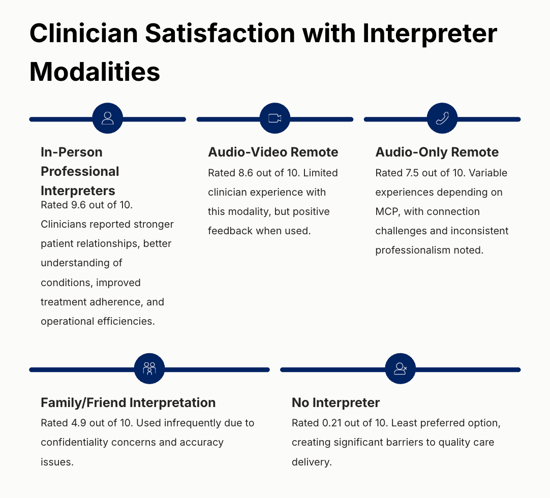
Clinicians rated in-person, video, audio-only interpreting, as well as friend/family, and no interpreter scenarios. Video interpretation ranked second, and the study reported that video provided many of the benefits of in-person interpretation, including the ability to see facial expressions and body language.
While the sample size for video encounters was small, the authors recommended shifting from audio-only models toward one that prioritizes video interpretation when feasible (p.241). They cited improved communication quality, visual cues, greater accessibility, and increased cost-effectiveness compared with in-person interpretation.
That recommendation aligns with a substantial body of research indicating that visual communication can improve comprehension, satisfaction, and the quality of communication during interpreted healthcare encounters. That's why Jeenie offers more languages on-demand in video...because it improves outcomes.
Communication Is Part of Care.
The most important lesson from MIPP isn't that professional interpreters improve communication.
Healthcare has understood that for years.
The more meaningful takeaway is that language access appears to influence outcomes healthcare organizations already care deeply about: preventive screenings, medication adherence, follow-up care, patient engagement, trust, and health equity.
When patients fully understand their care, they are better positioned to participate in it. And as MIPP demonstrates, participation is often what turns understanding into outcomes.
See the entire MIPP evaluation here.
Language access is value-based care.
If you want better outcomes for your patients, we can help.